THE MOLECULE
TWO ATOMS, ONE GAS
Molecular hydrogen, written H₂, is two hydrogen atoms joined together. It’s a colourless, odourless gas, small enough to diffuse across cell membranes and reach deep into the cell.

Why molecular hydrogen?
Hydrogen is the smallest, lightest element, and one of the most essential for life.
Before there was a human, or a tree, there was hydrogen. It has always played a role in living organisms. Over the past 20 years, molecular hydrogen has been increasingly studied, with over 4,000 scientific publications to date, exploring how it may support the body’s own balance, down to the cellular level.

Understand the molecule
Molecular hydrogen is a relatively unreactive diatom that researchers are studying for how it may interact with biological processes involved in mitochondrial, oxidative, and inflammatory
signalling.
Molecular hydrogen, written H₂, is two hydrogen atoms joined together. It’s a colourless, odourless gas, small enough to diffuse across cell membranes and reach deep into the cell.
Reactive molecules have normal signalling roles in the body. When oxidation outweighs the body’s ability to regulate it, the result is oxidative stress. Research suggests H₂ may help restore that balance, by supporting its own regulatory systems while leaving useful signalling intact.
Natural: the most abundant element in the universe.
No build-up: what the body doesn’t use is simply exhaled.
Non-toxic: well tolerated, even at high concentrations.
One molecule. Two routes.
Both approaches involve H₂. They deliver it differently, and their research should be read separately.
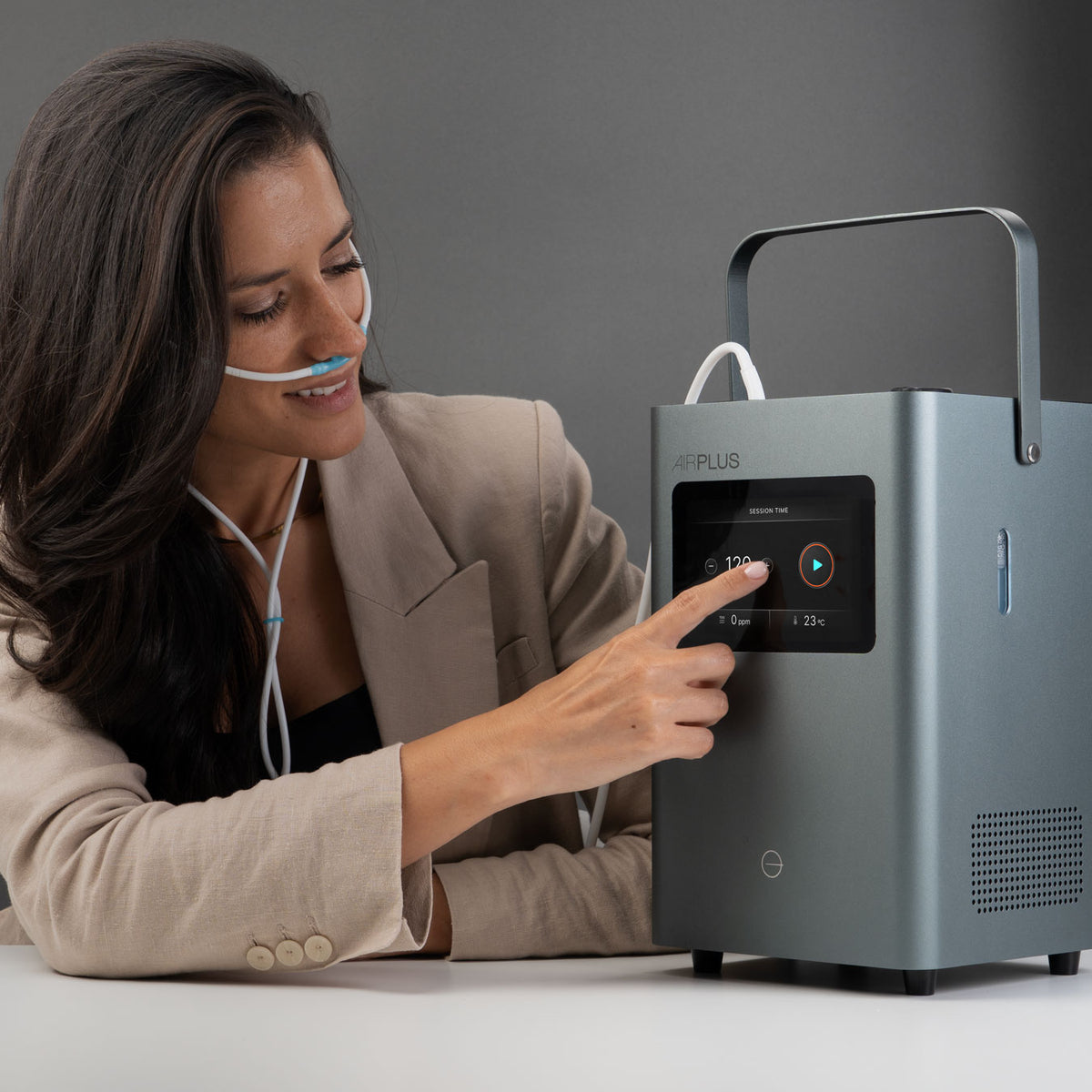
H₂ generated in the inhaler is delivered as a gas through a nasal cannula during a breathing session. Research varies by gas mixture, flow rate, duration and setting.
Gas output in ml/min is an equipment specification. It is not the same as the concentration a person inhales or the amount their body receives. A higher output alone does not establish a greater health benefit.

The hydrogen in ordinary water is chemically bound to oxygen. Hydrogen-rich water contains additional H₂ gas dissolved in the liquid. The concentration when you drink, the volume and the preparation method all affect the exposure.
Hydrogen-rich water is not defined by its alkalinity: pH and dissolved H₂ are different measurements. Water trials cannot automatically support claims about inhalation, or vice versa.
The research
Selected human studies at rest, around exercise and over several weeks. Open a topic for the protocol, findings and limitations.
A controlled study found a shift towards greater fat oxidation during a resting session.
Grepl et al. · 2025 · Randomised, double-blind, placebo-controlled crossover.
Physically active women inhaled hydrogen or ambient air through a nasal cannula at 300 ml/min for 60 minutes at rest. Lower respiratory exchange ratios were consistent with greater fat oxidation, with a stronger relationship at higher body-fat percentages. This was not a trial of weight loss or lasting metabolic change.
An eight-week trial looked at oxidative-stress and lipid markers in adults with impaired glucose metabolism.
Kajiyama et al. · 2008 · Eight-week, randomised, double-blind, placebo-controlled crossover trial in 36 adults with type 2 diabetes or impaired glucose tolerance.
Hydrogen-rich water reduced markers of modified LDL, small dense LDL and urinary 8-isoprostanes compared with placebo water. In a small subgroup, 4 of 6 participants with impaired glucose tolerance normalised their oral glucose-tolerance test, but the subgroup was too small to draw conclusions. The protocol used 900 ml of hydrogen-rich water per day, a study-specific amount, not a specification for a consumer product.
A four-week trial measured changes in immune cells and inflammatory signalling.
Sim et al. · 2020 · Randomised, double-blind controlled trial in healthy adults.
Participants drank 1.5 L daily for four weeks. Some immune-cell and inflammatory signalling measures changed. Overall between-group changes in blood oxidative-stress markers were not significant. These are laboratory findings, not an established general antioxidant benefit.
Controlled studies reported less perceived fatigue after cycling and better preservation of jump performance during recovery.
Dong et al. · 2024 · Randomised, double-blind crossover in healthy men.
After 60 minutes of hydrogen-rich gas or placebo before intense cycling, perceived fatigue, exertion and post-exercise lactate favoured hydrogen. Jump height did not differ. The results concern one exercise session.
Shibayama et al. · 2020 · Double-blind crossover pilot.
Hydrogen-rich gas during post-exercise recovery better preserved jump height and reduced a urinary DNA-oxidation marker. Other exercise-performance and muscle-damage measures did not differ from placebo.
An acute trial reported lower lactate and perceived exertion at higher cycling intensities.
Botek et al. · 2019 · Randomised, double-blind, placebo-controlled crossover in healthy men.
After 600 ml before incremental cycling, lactate was lower at higher intensities. Perceived exertion and ventilatory efficiency also favoured hydrogen water at the highest tested intensity. This was an acute exercise protocol.
A six-week pilot investigated muscle-damage markers alongside resistance training.
Kuzmanovic et al. · 2025 · Six-week, double-blind, placebo-controlled pilot in previously untrained adults over 50.
With resistance training, hydrogen water reduced selected muscle-damage markers more than control water. Performance improved in both groups; the sleep-quality difference was not statistically significant. The protocol used 12 mg H₂ per serving, twice daily — a preparation-specific amount, not a specification for a consumer bottle.
A controlled running study found no improvement in time to exhaustion.
Valenta et al. · 2022 · Randomised, double-blind, placebo-controlled crossover in trained male runners, including adolescents.
Drinking 1,260 ml before running at maximal aerobic speed did not improve time to exhaustion or the measured lactate, heart-rate and oxygen-uptake outcomes. Null results are part of the evidence.
Researchers measured heart-rate regulation and blood-oxygen saturation during inhalation at rest.
Grepl et al. · 2026 · Randomised, double-blind, placebo-controlled crossover in physically active women.
After 60 minutes at rest, autonomic cardiac regulation did not differ. Mean oxygen saturation was 95.9% with hydrogen and 96.7% with placebo; the authors considered the reduction not clinically significant. This is a specific short-term physiological finding, not proof of general safety.
An exploratory study measured short-term changes in prefrontal oxygenation and autonomic activity.
Moriya et al. · 2026 · Single-session study without a placebo group.
Healthy adults received hydrogen at 300 ml/min for 30 minutes. Researchers observed a transient change in prefrontal oxygenation asymmetry and autonomic measures. The study did not test memory, attention or cognitive improvement. The fraction of hydrogen actually inhaled was not measured.
These small studies used other equipment, preparations and differing protocols. None tested a CellPowerX product, and they do not establish long-term effects. The same output in ml/min does not make a device equivalent to a study protocol.
Different populations
These studies concern people with diagnosed conditions. They are shown separately because their findings cannot be extended to healthy users of consumer equipment.
Botek et al. · 2022 · Randomised, single-blind, placebo-controlled study.
A two-week inhalation protocol in adults recovering from COVID-19 reported improved walking capacity and selected lung-function measures compared with placebo. This concerns a defined post-illness population.
Zheng et al. · 2021 · Multicentre, randomised, double-blind trial.
A hydrogen–oxygen mixture improved combined breathlessness, cough and sputum scores compared with oxygen alone in hospital patients. Lung-function and blood-oxygen outcomes did not differ significantly.
Clinical research does not describe an intended use of AirGo or AirPlus. Do not recreate hospital protocols at home or replace prescribed care.
From research to equipment
Three equipment variables help describe a system. None, on its own, establishes a health benefit.
AirGo and AirPlus have a published H₂ purity specification of 99.99%. This describes the produced hydrogen gas.
When gas is delivered through an open nasal cannula, it mixes with room air. The purity at the outlet is not the concentration of the entire breath.
AirGo produces 300 ml/min of H₂; AirPlus produces 600 ml/min. Output measures gas production per minute.
Exposure also depends on breathing, gas mixture, delivery setup and session length. A matching flow rate does not establish an identical dose or the same result as a study.
Both systems offer 30–360 minutes in 30-minute steps. Choose and use equipment according to its instructions.
The maximum timer setting is an operating limit. It is not a recommendation to inhale for that duration.
Which one is for you?
Total gas output (ml/min)
 900 ml/min
Hydrogen (H₂) (ml/min)
600 ml/min
Water reservoir (ml)
2,000 ml

The same five core technologies in both
Published equipment specifications. Both systems offer Pure H₂ and H₂/O₂ delivery modes. Higher output is not evidence of greater clinical effectiveness.
Your next step
See the practical differences between AirGo and AirPlus, or ask our team about setup and specifications.